Top all-time · #1253
I Like Big Bits
Personal blog · ilikebigbits.com/blogprogrammingsystems
I Like Big Bits is a personal blog at ilikebigbits.com about programming and systems. Since 2015, 54 different Hacker News readers have linked it 72 times, most often “The Myth of RAM (2014)”. No feed was found, so read it on the site itself.
Sometimes recommended · 6 of 33 sampled comments recommend it?
Why HN links it
HN readers link Ryan Fleury's 'The Myth of RAM' series, which argues memory access time scales with the square root of data size rather than O(1). It is cited for big-O and hash table performance.
Summarised by Claude from a sample of 33 HN comments that link here. Each comment is marked recommending, critical or neutral (citing without judging); how this works.
Most-linked posts?
- The Myth of RAM (2014)15 people · 16 mentions · first linked 2019-09-15
- The Myth of RAM (2014)8 people · 8 mentions · first linked 2015-02-09
- The Myth of RAM (2014)6 people · 9 mentions · first linked 2018-11-27
- The fastest code is the code that never runs: adventures in optimization4 people · 4 mentions · first linked 2015-12-06
- Programming in 1969: An interview with a pioneer – my mum4 people · 4 mentions · first linked 2019-08-07
- The Unfixable Bug3 people · 3 mentions · first linked 2016-11-23
- Float or double?3 people · 3 mentions · first linked 2017-06-01
- Designing a fast hash table3 people · 3 mentions · first linked 2016-08-28
- /blog/2014/4/28/the-myth-of-ram-part-ii2 people · 2 mentions · first linked 2016-08-29
- Abstractions: a cautionary tale2 people · 2 mentions · first linked 2017-04-23
What Hacker News says?
This series of blog posts explains this sqrt behaviour quite nicely, covering both theory (including black holes) and practice: http://www.ilikebigbits.com/2014_04_21_myth_of_ram_1.html
Comment linking /2014_04_21_myth_of_ram_1.html
on “Ask HN: What are some cool but obscure data structures you know about?”Submitted The Myth of RAM (2014) as a story · 593 points
HN discussionThere was an article that mentioned that cbrt(n) is worst-case array access, not constant time. They did some benchmarks across the CPU cache/RAM/SSD boundary to show this practically. I can't seem to find it though, where was it? Edit: found it, https://www.ilikebigbits.com/2014_04_21_myth_of_ram_1.html
Comment linking /2014_04_21_myth_of_ram_1.html
on “4B If Statements”Submitted Programming in 1969: An interview with a pioneer – my mum as a story · 186 points
HN discussionHe addresses using the third dimension in detail in part II: http://www.ilikebigbits.com/blog/2014/4/28/the-myth-of-ram-p...
Comment linking /blog/2014/4/28/the-myth-of-ram-part-ii
on “The Myth of RAM (2014)”Submitted Programming in 1969 as a story · 182 points
HN discussionNo, it will never level off. You'll always eventually expand past the limits of whatever storage you're using. It's clearly impossible to build totally unlimited storage with constant access time, and you'll always eventually need larger storage (to disk, to other machines, to other data centres, etc), at the cost of speed. Take a look at [part two]( http://www.ilikebigbits.com/blog/2014/4/28/the-myth-of-ram-p... ),…
Comment linking /blog/2014/4/28/the-myth-of-ram-part-ii
on “The Myth of RAM (2014)”Submitted Simple coroutines for games in C++ as a story · 93 points
HN discussionAre your questions maybe answered in part IV of the series, the FAQ[1]? [1] http://www.ilikebigbits.com/blog/2015/2/9/the-myth-of-ram-pa...
Comment linking /blog/2015/2/9/the-myth-of-ram-part-iv
on “The Myth of RAM (2014)”Submitted Designing a fast hash table as a story · 67 points
HN discussionAt some point both higher latencies and deeper cache hierarchies seem inevitable: http://www.ilikebigbits.com/2014_04_21_myth_of_ram_1.html Though, perhaps 3D integration can stave that off for many more generations.
Comment linking /2014_04_21_myth_of_ram_1.html
on “AMD Ryzen 9 3950X Review”Submitted Error Context – a stack trace for data as a story · 25 points
HN discussion> The address space will be shared on the whole cluster, supported by an interconnect that’s so fast that most researcher can just stop caring about communication / data locality There will always be people who will care because locality will always matter (thanks, physics). Improvements in technology may make it easier and cheaper to solve today's problems, but as technology improves we simply begin to tackle new,…
Comment linking /2014_04_21_myth_of_ram_1.html
on “Fortran is still a thing”Submitted The Unfixable Bug as a story · 24 points
HN discussionYes. Here is a four-part series exploring RAM models: http://www.ilikebigbits.com/blog/2014/4/21/the-myth-of-ram-p...
Comment linking /blog/2014/4/21/the-myth-of-ram-part-i
on “A new fast hash table in response to Google’s new fast hash table”Submitted The Unfixable Bug as a story · 11 points
HN discussionI really liked this series: http://www.ilikebigbits.com/blog/2014/4/21/the-myth-of-ram-p... While, like others have said, big O and execution are different, in practice the article makes a lot of sense when evaluating execution.
Comment linking /blog/2014/4/21/the-myth-of-ram-part-i
on “A new fast hash table in response to Google’s new fast hash table”Submitted The fastest code is the code that never runs: adventures in optimization as a story · 6 points
HN discussionHave you compared it to this implementation? http://www.ilikebigbits.com/blog/2016/8/28/designing-a-fast-...
Comment linking /blog/2016/8/28/designing-a-fast-hash-table
on “I Wrote My Fastest Hashtable”Submitted The Myth of RAM as a story · 5 points
HN discussionThe problem is that the most used memory model for algorithms performance research is not true in the real world: O(1) memory access. In the real world memory access is not a O(1) operation, it takes a different amount of time to access memory in the different levels of cache. https://www.ilikebigbits.com/2014_04_21_myth_of_ram_1.html
Comment linking /2014_04_21_myth_of_ram_1.html
on “You're doing it wrong: B-heap 10x faster than binary heap (2010)”Submitted The Myth of RAM (2014) as a story · 4 points
HN discussionYeah the justification I gave is pure theory until you're talking large distributed systems... and the theory amuses me here so I'm going to keep talking about it first. But it's actually a place where practice happens, by coincidence, to match theory pretty well: https://www.ilikebigbits.com/2014_04_21_myth_of_ram_1.html
Comment linking /2014_04_21_myth_of_ram_1.html
on “SIMD within a register: How I doubled hash table lookup performance”Submitted Programming in 1969: An interview with my mom as a story · 4 points
HN discussionhttps://www.ilikebigbits.com/2014_04_21_myth_of_ram_1.html
Comment linking /2014_04_21_myth_of_ram_1.html
on “SIMD within a register: How I doubled hash table lookup performance”Submitted The Myth of RAM as a story · 3 points
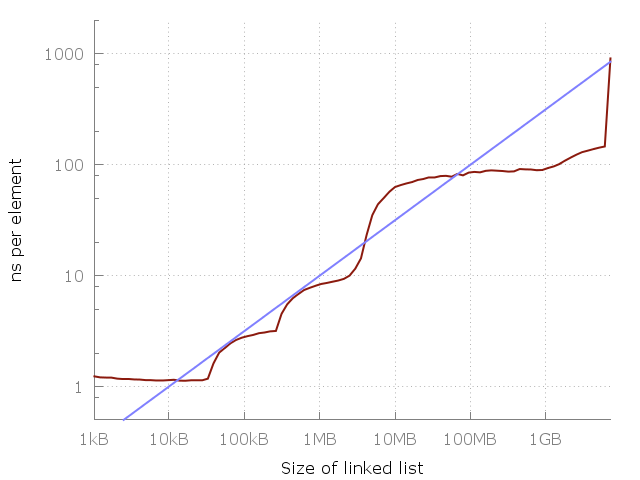
HN discussionThe empirical argument actually states that memory access is O(n^1/2) https://www.ilikebigbits.com/2014_04_21_myth_of_ram_1/3_fit.... "The blue line is O(√N)." This has been rehashed many times before, and the best blog post on this topic is here: https://www.ilikebigbits.com/2014_04_21_myth_of_ram_1.html
Comment linking /2014_04_21_myth_of_ram_1.html
on “Memory access is O(N^[1/3])”Submitted The Myth of RAM (2014) as a story · 3 points
HN discussionI mean, if you want to talk about our actual tech, it's bound by lithography of silicon chips, which are largely n^2, on printed circuit boards, which are n^2, on the surface area of the earth, which is n^2. This has been observed since at least 2014: https://www.ilikebigbits.com/2014_04_21_myth_of_ram_1/3_fit.... Pretty much every physical metric pegs memory access as O(n^1/2).
Comment linking /2014_04_21_myth_of_ram_1/3_fit.png
on “Memory access is O(N^[1/3])”Submitted The fastest code is the code that never runs as a story · 3 points
HN discussion