Top all-time · #3220

William Mitchell
Personal blog · bilbo.economicoutlook.net/blogeconomicspolitics
William Mitchell's personal blog at bilbo.economicoutlook.net covers economics and politics. Since 2010, 23 different Hacker News readers have linked it 95 times. It is still writing: the last post was on 2026-11-02, and you can follow it by feed.
Sometimes recommended · 6 of 39 sampled comments recommend it?
Why HN links it
HN readers link William Mitchell's economics blog as a source on Modern Monetary Theory, money creation, banking and inflation, and as a critique of neoliberal economics.
Summarised by Claude from a sample of 39 HN comments that link here. Each comment is marked recommending, critical or neutral (citing without judging); how this works.
Home Page and Digital Archive of Professor William Mitchell
Most-linked posts?
- /blog/4 people · 4 mentions · first linked 2011-08-07
- /blog/?p=37733 people · 15 mentions · first linked 2010-08-06
- /blog/?p=146202 people · 3 mentions · first linked 2015-07-20
- /blog/?p=317152 people · 3 mentions · first linked 2016-04-28
- /blog/?p=237192 people · 2 mentions · first linked 2016-04-04
- /blog/?p=439972 people · 2 mentions · first linked 2020-07-27
- /blog/?p=323962 people · 2 mentions · first linked 2018-03-17
- /blog/?p=119412 people · 2 mentions · first linked 2011-09-09
- /blog/?p=90752 people · 2 mentions · first linked 2020-03-15
What Hacker News says?
A universal basic income is inferior to a job guarantee: http://www.economonitor.com/lrwray/2013/07/09/how-big-is-big... http://neweconomicperspectives.org/2014/01/16-reasons-matt-y... https://www.reddit.com/r/BasicIncome/comments/3ne2iu/randall... ? http://bilbo.economicoutlook.net/blog/?p=13025
Comment linking /blog/?p=13025
on “A Basic Income Should Be the Next Big Thing”Submitted We need more artists and fewer entrepreneurs (2013) as a story · 3 points
HN discussion> The first operation ("writing a number on a computer") can occur regardless of how much money the bank has. But if operation 2 is not possible, then the number that was created in operation 1 is de facto not money. Remember, we're arguing whether the bank needs to have physical banknotes and central bank reserves in order to "create money" when originating a loan. We're not arguing about whether the bank can type…
Comment linking /blog/?p=9075
on “FTX tapped into customer accounts to fund risky bets, setting up its downfall”Submitted US labour market – things are getting worse again as the virus spreads as a story · 2 points
HN discussionThat's nonsense. Zimbabwe (like the famous Weimar republic, by the way) had a extreme fall in the real productive capacity of the economy (1). Inflation was going to happen nevertheless the monetary policy they adopted. (1) - http://bilbo.economicoutlook.net/blog/?p=3773
Comment linking /blog/?p=3773
on “African leaders launch landmark 55-nation trade zone”Submitted Taxes for Revenue Are Obsolete (1946) [pdf] as a story · 2 points
HN discussionAll econ is fairly subjective. Hence the "dismal" science label. search for "Volker" http://bilbo.economicoutlook.net/blog/?p=7591
Comment linking /blog/?p=7591
on “Consumer prices rose 8.5% in March – highest since 1981”Submitted Setting things straight about the Job Guarantee as a story · 1 points
HN discussionQuote: "I think it's just not a very human mindset. I've talked to natural scientists and social scientists alike. All of them want their research to succeed, they all want to get their PhDs, get good results for their postdocs, get publications going etc." And that is one of the major problems. Hubris and arrogance and thus bad requirements and expectations and thus cheating and lies and half-truths as normal behav…
Comment linking /blog/?p=39198
on “The Lifespan of a Lie – Why can’t we escape the Stanford Prison Experiment?”And you can get your daily dose of economic sense directly from Bill Mitchell's blog. He's just done a two day debunking of the usual nonsense that has now found its way into literature. http://bilbo.economicoutlook.net/blog/?p=36850
Comment linking /blog/?p=36850
on “A New Way to Learn Economics”When you say that Japan's debt is mostly bought by Japanese it sounds like it's a particularity of the Japanese people. That's not the case. Who is buying that debt is really the Central Bank of Japan, so, it's really a political decision. Yes, the central bank have a target interest rate and operate to keep it inside their chosen parameters. Lenders accept that decision because they have not other option. From http…
Comment linking /blog/?p=40937
on “The U.S. Yield Curve Has Inverted”"[..] The balance sheet of the BOJ as recently passed its annual GDP." Yes, and where are the promised terrible consequences? The true is the markets have to dance whatever the Central Bank sings [1]. [1] - http://bilbo.economicoutlook.net/blog/?p=40937
Comment linking /blog/?p=40937
on “The U.S. Yield Curve Has Inverted”How your theory explain Japan? Are they extraordinarily good with money? The interest rate is chosen by the central bank, not by "the market" [1]. A different issue is who try to influence that decision [2]. [1] - http://bilbo.economicoutlook.net/blog/?p=40250 [2] - http://bilbo.economicoutlook.net/blog/?p=32029
Comment linking /blog/?p=32029
on “The U.S. Yield Curve Has Inverted”This is a common misconception: that treasuries somehow don't lead to inflation but reserves (aka electronic cash) somehow do. Why? Both are extremely liquid, but treasuries pay more interest than reserves (yes, reserves do pay interest [1]). The only difference between treasuries and reserves is, in fact, the interest rate an the fact that we call one "debt" and the other "money". But they are both US federal gov't…
Comment linking /blog/?p=31715
on “The U.S. Yield Curve Has Inverted”>>"Some other countries [the exception not the rule] have been more prudent with their finances" I'm going to dispute that this have something to do with "prudence". If an economy grows (bigger GDP), that means that more money is spent in the economy. That money have to come from somewhere otherwise there will be not grow (1). New Zealand have a positive commercial balance, that's where the money is coming from. Obv…
Comment linking /blog/?p=21287
on “Ask HN: What are you reading to make sense of the economy?”We will never agree in what makes sense explaining economy because it's a political question. The first thing to do, in my opinion, is to accept that. For me, personally, after trying to make sense for a while using the mainstream narrative, the only thing that worked was Modern Monetary Theory. Their explanation of the banking system is based in how it really works (mainstream textbooks don't), the sectoral balance…
Comment linking /blog/?page_id=33139
on “Ask HN: What are you reading to make sense of the economy?”In addition to universal basic income the government should guarantee a job to anyone who wants to work, which effectively sets a minimum wage[0] Also, it's stupid to exclude immigrants or to have a "closed border" policy, because more people means more labour and more resources. The economy booms BECAUSE of immigration if handled correctly. Economics is such a confused profession ... y'all must be embarrassed. [0]…
Comment linking /blog/?p=23719
on “A Basic Income Is Smarter Than a Minimum Wage”As a US citizen you may not be aware of this, but the time between 1970 and 1980 was also when full employment was effectively abandoned as a policy goal in most Western countries. In countries like France, Germany and Australia, unemployment was constantly below 4% for many decades after WWII, even below 1% in many cases. What's more, rises in the unemployment rate due to recessions were quickly and successfully fo…
Comment linking /blog/?p=11941
on “Share of Income Gains by Quintile - Great Depression til Now”Well in a nutshell, the US government makes the money. It can never run out. So it isn't dependent on tax revenue to spend. So the limitations on spending are elsewhere. This is a good intro: http://elliswinningham.net/index.php/the-basics/us-currency-... http://elliswinningham.net/index.php/the-basics/us-currency-... http://elliswinningham.net/index.php/the-basics/us-currency-... Also maybe: http://bilbo.economicou…
Comment linking /blog/?p=9281
on “Anthony Bourdain on not having debt”I do not think the US is unique, indeed I would say that all modern western countries suffer the same problem. The elites were closet supporters of fascism until they weren't. Then we had this anomalous period from the end of WW2 until the early 1970s when the Keyensians were dominant and governments pursued full employment economies via fiscal policy. The elites really can't abide sharing with labour, and capitalis…
Comment linking /blog/?p=32776
on “Make elites compete: Why the 1% earn so much and what to do about it”Reserve requirements never really limited the ability of banks to create money. Canada hasn't had reserve requirements for >20 years. Neither does the UK, New Zealand, Australia, Sweden and Hong Kong. But all banks are indeed subject to capital requirements, and that does limit money creation Anyway, reserve requirements are generally not effective, including in the USA. Much has been written about this. Banks are u…
Comment linking /blog/?p=9075
on “Federal Reserve slashes interest rates to zero”The idea that a government with control over its own currency can print money to pay debt without significant inflation is a part of Modern Monetary Theory. Here's a blog post explaining it: http://bilbo.economicoutlook.net/blog/?p=31715
Comment linking /blog/?p=31715
on “Japan surpasses China as largest foreign holder of US Treasurys”Can you support that with some data of citation? I would recommend you to read the below link. It doesn't seem to me that the problem was "printing too much money". From http://bilbo.economicoutlook.net/blog/?p=3773 : -Unemployment rose to 80 per cent or more and many of those employed scratch around for a part-time living. -45 per cent of the food output capacity was destroyed. -In 2007, there was a 57 percent decl…
Comment linking /blog/?p=3773
on “Japan surpasses China as largest foreign holder of US Treasurys”Most (all of them?) episodes of hyperinflation, including the infamous Weimar Republic and Zimbabwe, are not caused by "printing" too much money, but by a fall in the productive capacity of the economy. Here, Zimbabwe for hyperventilators: http://bilbo.economicoutlook.net/blog/?p=3773
Comment linking /blog/?p=3773
on “Japan surpasses China as largest foreign holder of US Treasurys”The Civil Services do not propose or enact laws. An EU member state is a representative democracy. https://en.wikipedia.org/wiki/Representative_democracy The EU is not. The non-democratic nature goes beyond legislation and affects the economy and poverty and austerity and taxes of members of the Eurozone who have given up their economic and thus political and thus democratic and cultural sovereignty. Granted, the de…
Comment linking /blog/?p=39549
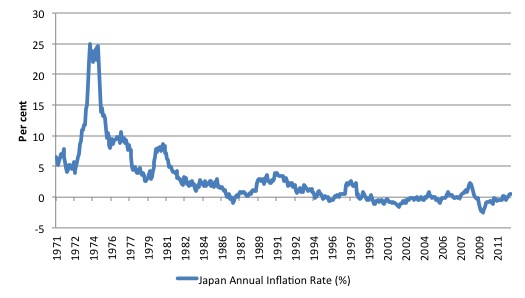
on “EU copyright reforms draw fire from scientists”An interesting though experiment would be to investigate what you expect to happen against what happened in Japan, which had basically flat inflation from 1992 to present: http://bilbo.economicoutlook.net/blog/wp-content/uploads/201...
Comment linking /blog/wp-content/uploads/2012/06/Japan_Annual_Inflation_Rate_1971_2011.jpg
on “What is energy, actually? (2011)”Actually, that it's not how it works in practice. The credit department of a bank, doesn't check if the bank have enough reserves before lending. They only check if the new lending make senses from a business perspective. If it does, it concede the credit to the customer. The bank is legally obliged to have the reserves, so, a posteriori (and not before) the bank will try to get the reserves in the inter-bank market…
Comment linking /blog/?p=14620
on “The ballooning money supply may be the key to unlocking inflation in the U.S.”You forget to mention that if you diminish the number of available burgers you'll need, also, more dollars to the get the same amount of cheeseburgers. And if you diminish the quantity of some essential product used for everything, as, for instance, energy, you will get the same effect. Also, people confuse a one time increase of prices with inflation (that is a constant increase in time), and inflation with hyperin…
Comment linking /blog/?p=3773
on “Inflation propagates unevenly”"If the government bought wheat, for instance, to keep its price high and keep farmers employed; then burns it, this creates asset misallocations, though it is technically creating demand (this still happens to this day.)" This has been done successfully but without the burning. Just keep the price stables buying when the price fall and selling when the price goes up. The idea of a buffer should be easy to understan…
Comment linking /blog/?p=23578
on “Why Are Corporations Hoarding Trillions?”Modern Monetary Theory reveals the entire premise of this issue to be false. The private sector does not fund the public sector in the way that most people believe. Non-convertible floating FX currency regimes (ie fiat money) such as the US,UK, and Japan can meet any and all financial obligations by issuing currency. Thus: 1) Taxes do not fund government. ( they 'back' the currency) 2) Treasury securities do not fun…
Comment linking /blog/
on “Just the Facts: S&P's $2 Trillion Mistake”