Top all-time · #4650

Karl Rupp
Personal blog · karlrupp.netsciencehardwareprogramming
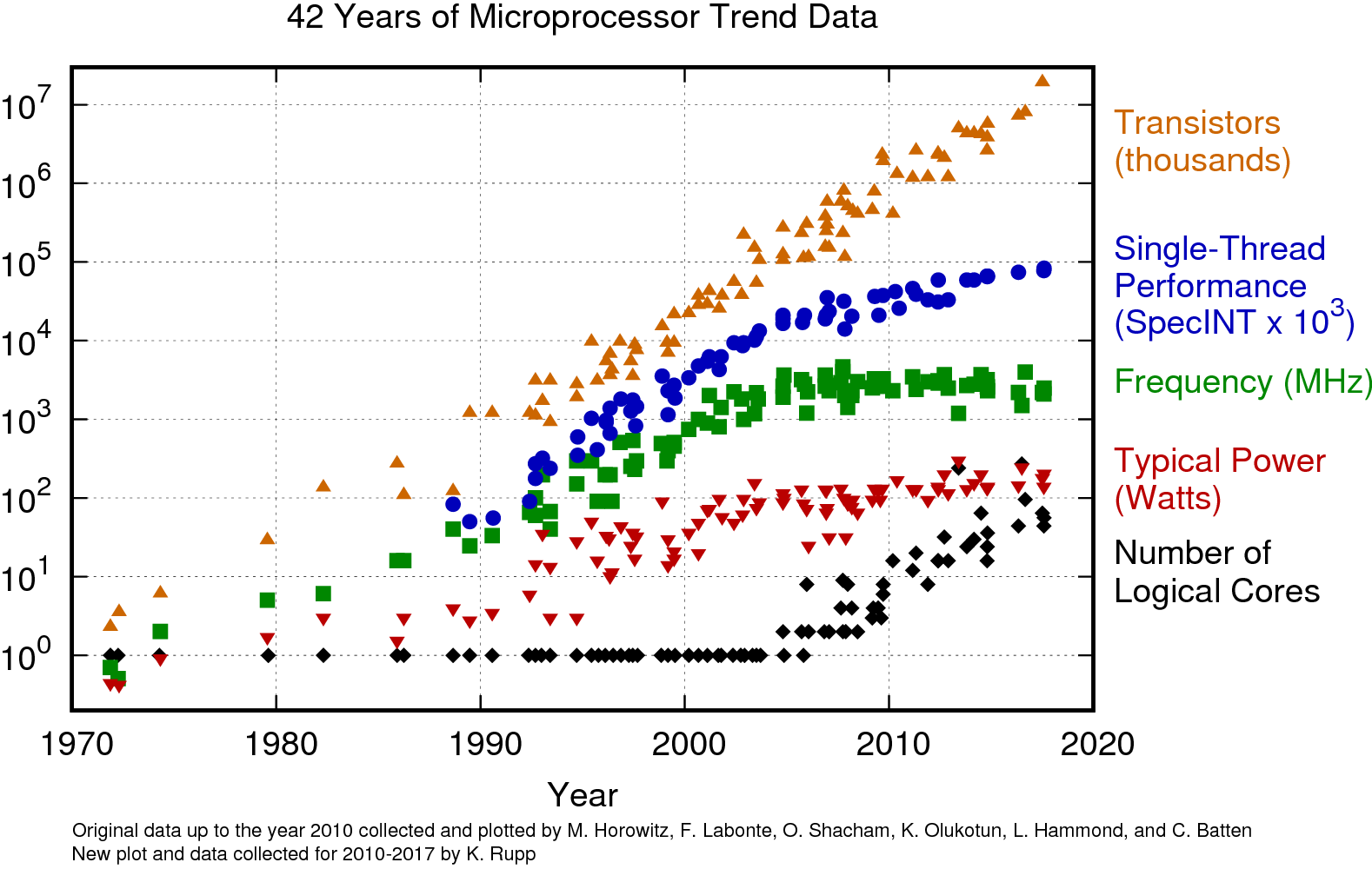
Karl Rupp's personal blog at karlrupp.net covers science, hardware and programming. Since 2016, 16 different Hacker News readers have linked it 25 times, most often “42 Years of Microprocessor Trend Data”. The last post was in 2018, but the archive is still widely read.
Too few sampled comments (12) to say how often HN recommends it.?
Why HN links it
HN readers link Karl Rupp's posts for long-run microprocessor performance data and CPU/GPU comparisons. They cite them in debates on clock speeds, Moore's law, vectorization and benchmarks.
Summarised by Claude from a sample of 12 HN comments that link here. Each comment is marked recommending, critical or neutral (citing without judging); how this works.
Most-linked posts?
- 42 Years of Microprocessor Trend Data5 people · 5 mentions · first linked 2018-02-15
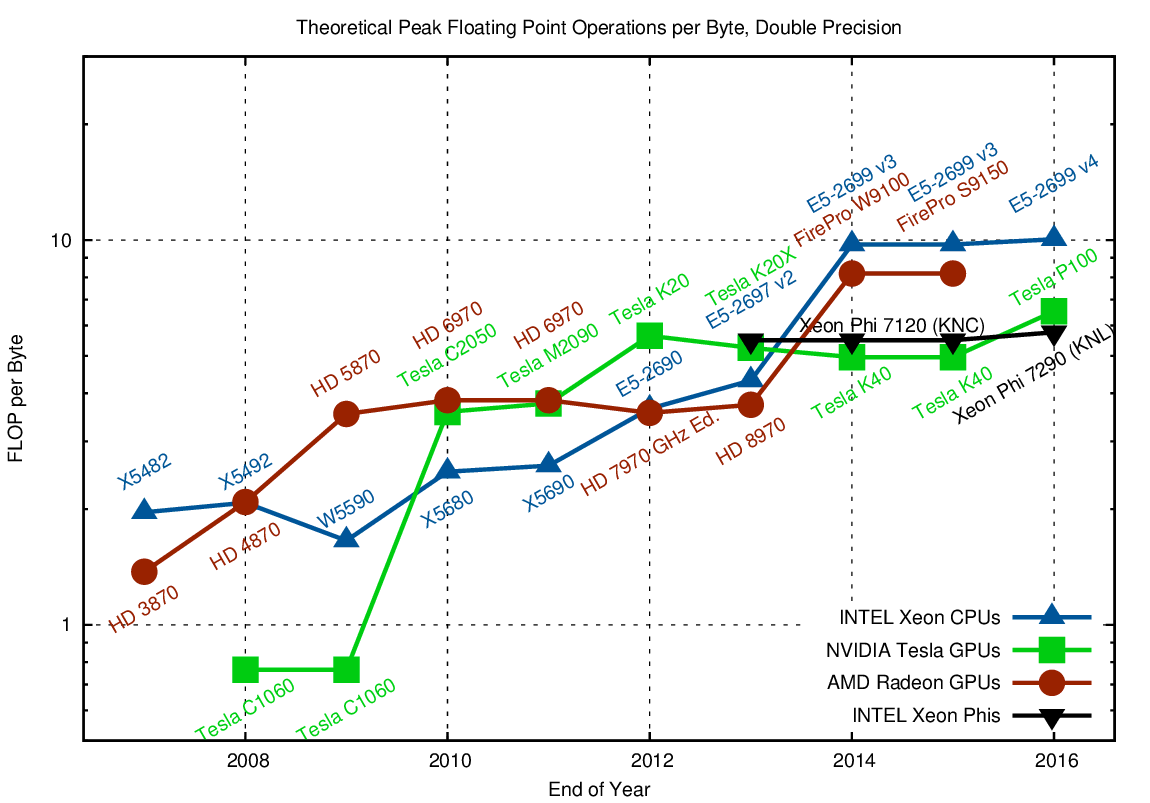
- /2013/06/cpu-gpu-and-mic-hardware-characteristics-over-time/4 people · 4 mentions · first linked 2016-02-16
- 40 Years of Microprocessor Trend Data (2015)4 people · 4 mentions · first linked 2017-04-19
- Strided Memory Access on CPUs, GPUs, and MIC2 people · 2 mentions · first linked 2016-02-15
What Hacker News says?
>Except mobile hardware which does not. Source? RAM available in mobile phones seems to grow exponentially [1]. Power efficency of processors also seems to grow exponentially [2] (does anybody have a source for ARM processors?). [1]: https://i.imgur.com/AWkmMJc.png (note logarithmic scale) [2]: https://www.karlrupp.net/2013/06/cpu-gpu-and-mic-hardware-ch...
Comment linking /2013/06/cpu-gpu-and-mic-hardware-characteristics-over-time/
on “Multi-process Firefox brings 400-700% improvement in responsiveness”Submitted 40 Years of Microprocessor Trend Data (2015) as a story · 49 points
HN discussion> On all those benchmarks, (i.e. your standard LU matrix decomposition which previously was the basis of the LAPACK benchmarks, though things might have changed in the ~10 years since I've really looked at things) isn't CPU-bound anymore, so of course your instruction-per-cycle load on the CPU isn't where you'll be bottlenecking [...] That's incorrect, DGEMM and most BLAS3 is way above most if not all processor uarc…
Comment linking /wp-content/uploads/2013/06/flop-per-byte-dp.png
on “AMD Ryzen 7 1800X Benchmarked – Giving Intel’s $1000 Chips A Run For It”Submitted Sparse Matrix Transposition: Datastructure Performance Comparison as a story · 38 points
HN discussionfirstly Google was founded in 1998 that is 23 years ago. Secondly from 2000 - 2018 the internet went form having ~17.000.000 unique domains to having ~1.600.000.000 unique domains. see: https://www.internetlivestats.com/total-number-of-websites/ The performance for desktop computers have actually not increased as much as you would think: https://www.karlrupp.net/2015/06/40-years-of-microprocessor-... Your assumption…
Comment linking /2015/06/40-years-of-microprocessor-trend-data/
on “Debian's Chromium changes default search engine to DDG”Submitted Strided Memory Access on CPUs, GPUs, and MIC as a story · 4 points
HN discussionActually not true. Perhaps surprisingly, CPUs and GPUs are progressing at about the same rate if you look at the high end. GPUs are all about massive parallelism, and if you compare against high end Xeons, the CPU core count increases plus things like AVX512 & FMA means they have been scaling similarly to GPUs over the past 10 years or so. Nice analysis here (URL says 2013 but he has updated his numbers to end-2016)…
Comment linking /2013/06/cpu-gpu-and-mic-hardware-characteristics-over-time/
on “Fifty or Sixty Years of Processor Development for This?”Submitted Knights Landing vs. Knights Corner, Haswell, Ivy Bridge, and Sandy Bridge as a story · 2 points
HN discussionI really miss the 286->Pentium days when you had to buy a new machine every year because it would be literally 50-100% faster at everything. Every year! These days people call a 9% single-thread improvement a good year. https://www.cpubenchmark.net/year-on-year.html https://www.karlrupp.net/wp-content/uploads/2018/02/42-years... BTW: Thanks for http://const.me/articles/simd/simd.pdf I came across it recently and pos…
Comment linking /wp-content/uploads/2018/02/42-years-processor-trend.png
on “Linux founder tells Intel to stop inventing magic instructions and fix problems”Submitted Multi-Threading in C/C++: Implications on Software Library Design as a story · 2 points
HN discussionNotably, single-thread performance of code that is not friendly to vectorization has not stagnated despite stagnant clock frequency. Indeed, SPECint performance continues to grow exponentially, albeit more slowly since ~2004. https://www.karlrupp.net/2018/02/42-years-of-microprocessor-...
Comment linking /2018/02/42-years-of-microprocessor-trend-data/
on “Why has CPU frequency ceased to grow? (2014)”Submitted 42 Years of Microprocessor Trend Data as a story · 1 points
HN discussion> the new CPU it's about 20% faster then the old one Source? I suspect you're being shown a few choice benchmarks which demonstrate some improvement, perhaps where something became newly vectorizable...but realistic and consistent benchmarking doesn't show nearly that level of improvement. One area in which you may benefit is in peripherals - an M.2 SSD and DDR4 RAM will help, and those aren't available on 5 year ol…
Comment linking /2018/02/42-years-of-microprocessor-trend-data/
on “Intel Announces 9th Gen Core CPUs”Submitted 40 Years of Microprocessor Trend Data – Karl Rupp as a story · 1 points
HN discussionPerformance/watt is improving greatly! Look at this plot [1] from about 2013 showing the theoretical perf/w of CPUs up to Ivy Bridge, and GPUs up to NVIDIA Kepler GK110 and AMD Hawaii XT. Since than both Intel with Haswell (and Skylake on Desktop) as well as NVIDIA Maxwell and AMD Fiji have improved tremendously The same article [3] shows clearly [2] that max TDP has increased a bit. [1] https://www.karlrupp.net/wp-…
Comment linking /2013/06/cpu-gpu-and-mic-hardware-characteristics-over-time/
on “Moore’s law really is dead this time”Submitted 40 Years of Microprocessor Trend Data (2015) as a story · 1 points
HN discussionIntel is in no way losing the HPC market. There are lots of algorithms (like all incompressible CFD, so all car/boat design, even sparse matrix multiply) that gets essentially zero benefit of GPU. At most, I'd say half the popular HPC use cases see significant GPU benefit. Karl Rupp has a very good series of CPU and GPU performance comparisons, recently updated: https://www.karlrupp.net/2013/06/cpu-gpu-and-mic-hardw…
Comment linking /2013/06/cpu-gpu-and-mic-hardware-characteristics-over-time/
on “ARM v8-A with Scalable Vector Extensions: Aiming for HPC and Data Center”Submitted Latency Comparison of Lua, OpenCL, and Native C/C++ as a story · 1 points
HN discussionFor interested folks, see also "42 Years of Microprocessor Trend Data" from Karl Rupp.[1] [1] https://www.karlrupp.net/2018/02/42-years-of-microprocessor-...
Comment linking /2018/02/42-years-of-microprocessor-trend-data/
on “Memory is slow, Disk is fast – Part 1”Submitted GEMM and STREAM Results on Intel Edison as a story · 1 points
HN discussionExcellent work! From the latest data ( https://www.karlrupp.net/2018/02/42-years-of-microprocessor-... ) you can definitely see that single-threaded performance is still increasing but not at the exponential clip it was. The inflection point for that is around the mid-2000s. It is hard to eyeball because the chart is logarithmic but the rate of increase looks to be sub-exponential for the past decade or so. MHz and…
Comment linking /2018/02/42-years-of-microprocessor-trend-data/
on “40 Years of Microprocessor Trend Data (2015)”Submitted Strided Memory Access on CPUs, GPUs, and MIC as a story · 1 points
HN discussionAlso see the updated text 42 Years of Microprocessor Trend Data > https://www.karlrupp.net/2018/02/42-years-of-microprocessor-... from 2018-02.
Comment linking /2018/02/42-years-of-microprocessor-trend-data/
on “40 Years of Microprocessor Trend Data (2015)”